Three Common Mistakes That Delay Council Approval
Tuesday 3 February 2026
Our Town Planning Team wanted to share with you three recurring mistakes that can significantly slow down council assessment time frames and hinder the way a proposal is prepared and presented to Council. Delays in the development approval process are a common frustration for applicants. While some factors are outside an applicant’s control, many delays stem from avoidable early stage decision making.
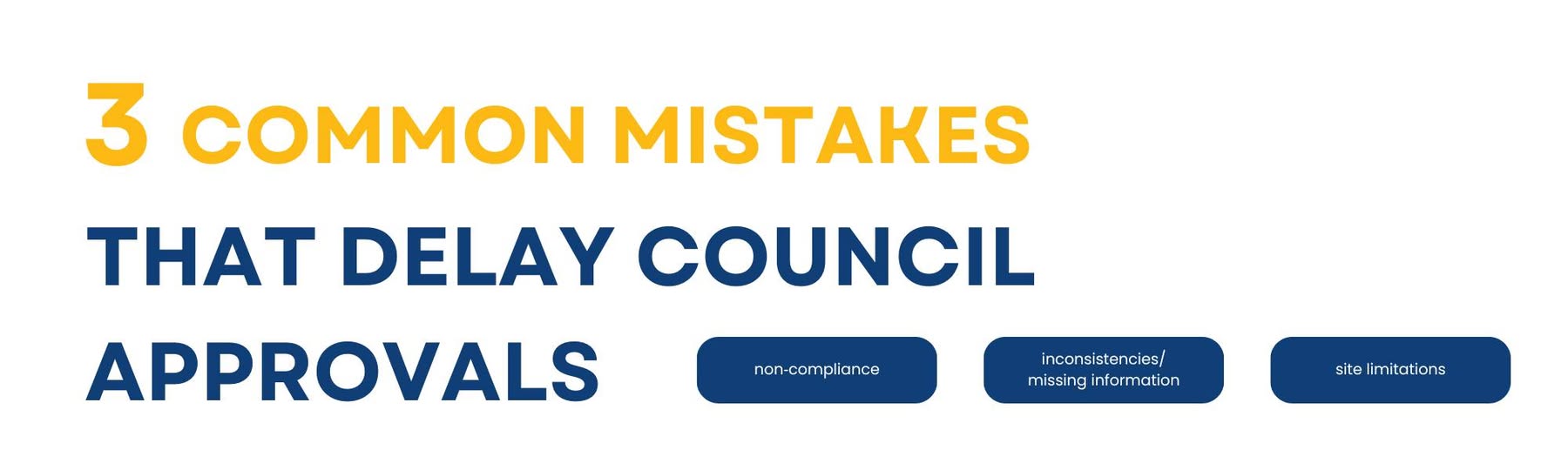
The first and most obvious delay is related to non‑compliance. Whether it’s exceeding height or floor space controls, inadequate setbacks, reduced solar access, lack of landscaping or failing to respond appropriately to local planning controls. Non‑compliances often trigger requests for information (RFI’s), redesign, or additional supporting documents. While non‑compliances are not always detrimental to an application, they must be categorised and refined by the level of priority for the client. Applications which have an abundance of non-compliances can be difficult to justify as having a positive development outcome for the site and surrounding properties.
The role of our Town Planning Team is to review and collate external sub-consultant reports and prepare the Statement of Environmental Effects for Council lodgement. This can lead to another frequent cause of delay, being inconsistencies, missing information, or attempts to take shortcuts in documentation. Incomplete plans, conflicting drawings, unclear reports, or missing consultant inputs create uncertainty for assessing officers and almost always result in additional information requests. While it may seem efficient to lodge an application quickly, cutting corners often leads to longer assessment periods overall, which is why reviewing plans and reports to ensure alignment prior to lodgement is highly important.
Finally, delays can often be pinpointed back to the selected development site’s limitations or uncertainty around the intended development outcome. Every site comes with constraints, whether environmental, physical or legislative. Failing to fully understand these within early development stages can lead to unrealistic proposals that require substantial revision. Early assessment of planning feasibility and a well‑defined development vision are critical to navigating the assessment process smoothly.
Good planning is not always about strict compliance, because realistically, complete compliance does not always guarantee a perfect outcome. Good planning is about investing time upfront to understand your sites limitations, refining your development goals, and selecting sub-consultants which contribute to a well‑prepared application, ultimately saving you time and money!
Back to News